
Traffic emission, tunnel junctions and much more at awards night
18 March 2026
COWIfonden's first awards night of the year was kicked off last Monday, unwrapping the latest research from five colleagues.
This time, Matthew Poulton from our London office, took the title for best presentation for his project on a methodology to reduce CO₂ emissions in constructing and maintaining highway bridges.
The climate challenge of slow-moving traffic
A significant portion of the carbon emissions associated with constructing and maintaining highway bridges comes from traffic disruption, in which vehicles travel further and slower than normal. Matthew Poulton's project aims to develop simple methodology for assessing the carbon impacts of temporary traffic management (TTM) that could be easily adopted by bridge engineers at the concept design stage, so that the most carbon-efficient solution could be identified.
Matthew explains: "Proposals using innovative rapid construction methods were often unfairly discounted at early optioneering stages on account of their high material embodied carbon. However, once the carbon savings from reduced traffic disruption are accounted for, they often come out on top. Indeed, this is what we found for two case studies evaluated as part of the project, one using a lightweight fibre-reinforced polymer bridge deck, and another using a modular abutment system".
Study proves, how the way you drive effect emissions
In the two case studies, the traffic carbon accounted for between 20% and 40% of the 'upfront' embodied carbon of the bridge structures, which was higher than expected. "However, analysis also showed that if the traffic flows are sufficiently low, imposing 80 km/hr temporary speed limit may lead to an overall carbon reduction, as most passenger vehicles are more fuel-efficient at this speed", says Matthew.
The proposed methodology combines data published by the UK Department for Transport on vehicle carbon emissions (webTAG) and a simple traffic model developed by National Highways.
Improved knowledge on precast tunnel junctions
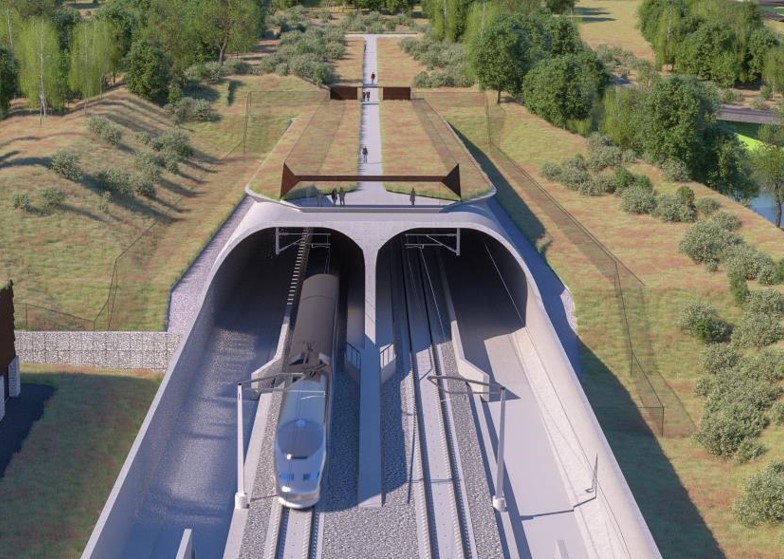
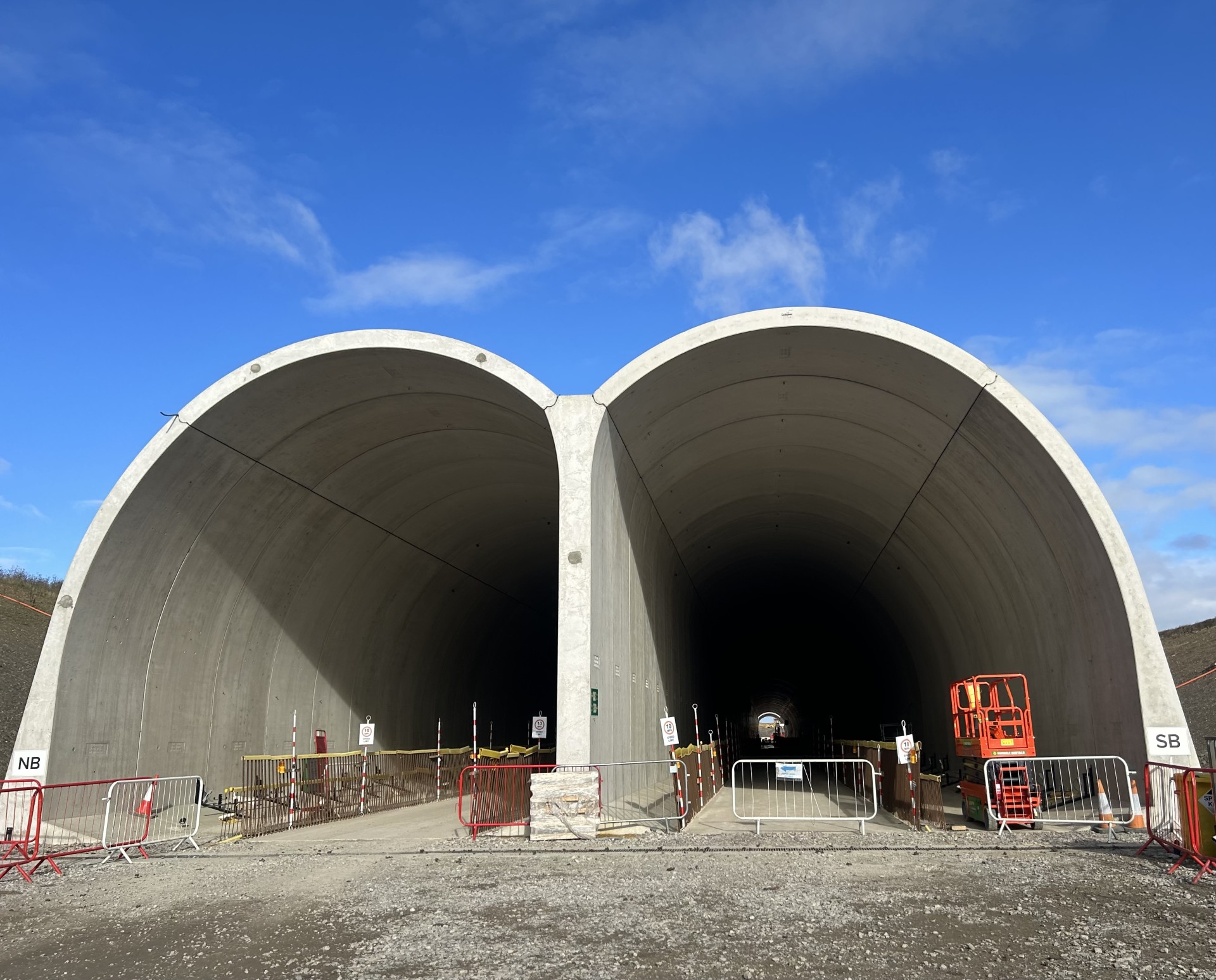
Another highlight of the awards night was the presentation from Mengxiao from COWI's Singapore office. Her project focuses on understanding how a special type of connection behaves in an innovative tunnel design. The case of the study, is a precast arched cut-and-cover tunnel, adopted in the HS2 Green Tunnel project in the UK, which is currently under construction.
Unlike conventional cut-and-cover tunnels that are typically built as rectangular concrete boxes cast on site, this system uses predominantly precast concrete elements manufactured off-site. The roof and wall components are installed on site and connected using a concrete-to-concrete knuckle joint, which allows a small amount of rotation between the elements.
"This design offers several advantages. Because the tunnel has an arched shape, it is structurally more efficient and requires less concrete and reinforcement, helping to reduce material use and embodied carbon. The use of prefabricated elements also enables faster construction with less onsite labour", explains Mengxiao
Still a lot to discover
However, since only few projects have adopted this structural concept, the understanding of joint behaviour is still limited. Another challenge observed during the construction of the HS2 Green Tunnel is the installation tolerance at the joint, which is difficult to achieve onsite. It is challenging to install the roof elements within a tight alignment tolerance relative to the wall units.
To investigate this, a series of physical tests were carried out by CERIB in France, using full-scale concrete elements representing the roof and wall of the tunnel. The objective of this study is to analyse the physical test results and calibrate the numerical modelling approach. Mengxiao elaborates: "By comparing the physical tests with the numerical simulations, we can assess the reliability of the model and improve the understanding of knuckle joint behaviour in this precast arch tunnel system".
More exiting projects from the awards night
Matthew and Mengxiao were just two presenters at COWIfonden's awards night. In the recording below, you can watch all five presentations.
| Name: | Organisation: | Topic of study: |
| Matthew Poulton | COWI UK Limited.UK & Ireland | Traffic disruption emissions for bridges |
| Mengxiao Li | COWI UK Limited / COWI Singapore Pte. Ltd. Tunnels, Civils and Underground Structures / International Activities |
Integrated Validation of Knuckle Joints in Precast Arched Tunnels Using Full-Scale Testing and Non-Linear Finite Element Modelling |
| Lilli Gruwier | COWI A/S (DK) Water and Environment |
From barriers to biodiversity: Towards Effective Management of Urban Biodiversity |
| Flemming Ruddi Mørk | COWI A/S (DK) Buildings and Industry East |
Investigation of downward deflection of concrete slabs during fire by using computational solution |
| Iver Blankenberg Schmidt | COWI A/S (DK) Renewable Energy DK |
From Waste to Value: Converting Nitrate-Rich Condensate from Carbon Capture into Fertilizer and Concrete Admixtures |
Related news
-
 30 September 2026
Global
Curiosity in Action
30 September 2026
Global
Curiosity in Action
-
 22 June 2026
Global
COWIfonden’s donations in the spring of 2026
22 June 2026
Global
COWIfonden’s donations in the spring of 2026
-
 18 June 2026
Global
3D concrete printing, PISA database and more from the latest awards night
18 June 2026
Global
3D concrete printing, PISA database and more from the latest awards night
Headquarters
COWI A/S
Parallelvej 2
2800 Kongens Lyngby
Denmark
Shortcuts
Sustainability and governance
Terms of use