
Curiosity in Action
30 September 2026
Four Rapid Innovation projects shaping the future of engineering
What happens when you give curious employees the freedom to explore an idea?
Read on and watch the presentations from September’s Awards Night below to find out!
Designed to encourage experimentation and fresh thinking, COWIfonden allocated DKK2.8 million for the 2026 Rapid Innovation initiative, which allows COWI employees and their external collaborators to test concepts, build prototypes, explore emerging technologies and investigate new solutions to industry challenges. Importantly, every project generates knowledge that extends beyond the organisation - with findings shared publicly to help advance the wider industry.
Four times a year, recipients come together to present their work at the virtual Awards Night, sharing their discoveries, lessons learned and ambitions for the future. Attendees are invited to ask questions and, at the end of the evening, vote for the project they found most inspiring.
This quarter's event featured four projects tackling everything from ship collisions and earthquakes to artificial intelligence and urban transport. While the topics varied widely, they all shared a common thread: a desire to challenge convention and find better ways of doing things.
The audience selected a winner, but it was a close contest with just 2 votes in it...
The people's choice: rethinking bridge protection for a new era of shipping
Ion Racu (COWI) - Parametric investigation of a Fender Structure for Bridge Pier Protection against Ship Collision.
The collapse of the Francis Scott Key Bridge in March 2024 brought renewed attention to a critical question for engineers worldwide: are our bridges adequately protected against vessel collisions?
For Ion, the incident highlighted a challenge he had already encountered through project work, and he asked himself: how can engineers better understand and improve the structures designed to protect bridges from ship impacts?
His Rapid Innovation project focused on fender systems: large protective structures positioned around bridge supports to absorb the force of a collision before a vessel can reach the bridge itself. Using advanced numerical modelling, Ion and his COWI colleagues Jens Henrik Nielsen, Henrik Gluver and Matt Yamasaki developed a flexible framework capable of simulating different ship sizes, soil conditions and structural configurations, allowing the team to explore how these systems perform under a wide range of scenarios.
What made the work particularly interesting was what happened beyond the limits normally considered in conventional design assessments.
Rather than simply identifying the point at which a structure reaches its design capacity, the research examined how it continues to behave after significant damage. The results showed that these systems possess significant reserve capacity, continuing to absorb energy even after exceeding traditional design thresholds.
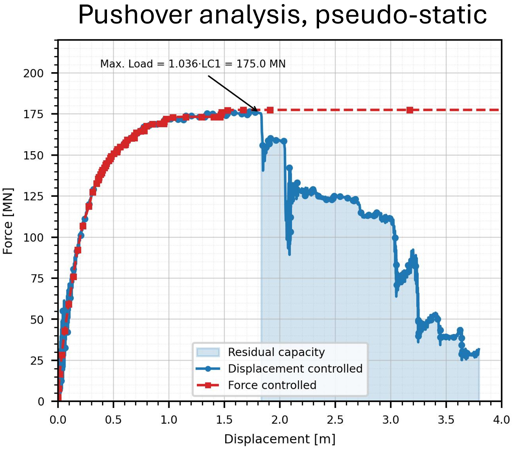
The research also revealed that the fender systems studied, when pushed beyond the design limit, tend to fail in a ductile manner, deforming gradually rather than collapsing suddenly. For engineers responsible for protecting critical infrastructure, that's an important insight – that fender type structures have some reserve capacity, even against ships bigger than the ones it was designed against.
Infrastructure owners around the world are reassessing the resilience of ageing structures and considering what additional protection may be required in the future. Ion believes tools like the one developed through this project could help guide those decisions.
The project has already led to a technical presentation within the Danish engineering community (DSBY) and a scientific paper for the IABSE SEI journal that is currently progressing through peer review to publication. What's more, some of the visualisation techniques and methods developed through the research have already been applied back into real-world project work.
"The nice thing was that we could use real data from an actual project, then generalise it so the wider engineering community can learn something from it." says Ion.
And this is only the beginning. Future research could compare different bridge protection solutions, helping engineers better understand which approaches offer the greatest resilience in different situations.
It was a compelling combination of practical relevance, technical innovation and future potential, earning the project the audience's vote as the evening's most inspiring presentation.
"We are aiming to show that this type of analysis can help not just COWI, but the wider engineering community design better structures and have more confidence in how they perform."
Ion Racu
Teaching AI to speak engineer
Mehdi Khakpour (COWI): AI Visual Exploration Tool for Architects and Road Planners
Artificial intelligence is rapidly changing how people work, create and communicate. But for engineers, architects and planners, many of today's AI tools still feel like they're speaking a different language.
That was the challenge that inspired Mehdi Khakpour's project.
The inspiration came from observing planners and designers experimenting with existing AI tools and encountering their limitations. While the technology itself was powerful, it often lacked the engineering understanding needed to produce meaningful results.
But what if exploring a new design idea was as simple as describing it?
The idea was simple: create a tool that helps engineers transform technical drawings into rich visual concepts, while preserving the context, constraints and logic that engineering projects require.
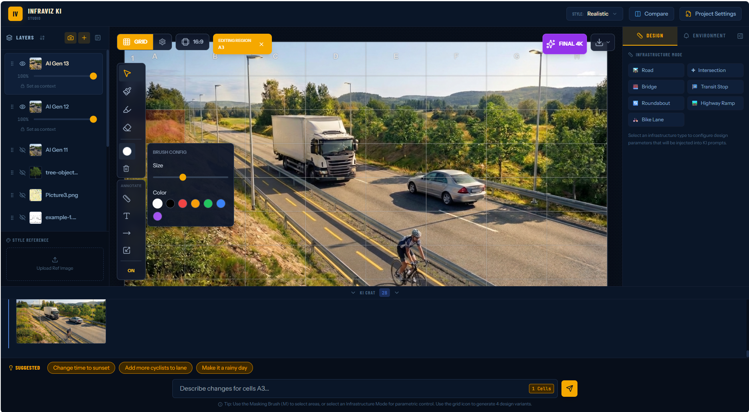
The resulting application can turn cross-sections, maps and sketches into detailed visualisations, bringing the power of generative AI to architects, road planners, and urban designers, enabling them to visualise, refine, and communicate concepts in seconds rather than hours. By transforming sketches, photos, and planning visuals through simple prompts, the tool aims to accelerate early-stage design, encourage creative exploration, and unlock new ways of collaborating across disciplines - thus bridging the gap between engineering expertise and AI capabilities.
"What we tried to do was facilitate communication between engineers and AI by providing the context that engineering projects require"
For Mehdi, the long-term potential stretches far beyond visualisation.
The project forms part of a broader vision where AI helps engineers move more seamlessly between data, models, drawings and design outputs. As AI tools become increasingly capable of understanding structured information, they may eventually support much larger parts of the engineering workflow.
The project has already attracted attention beyond COWI, with Mehdi preparing to showcase the work at an industry technology event in Norway; and he will also make the code publicly available, allowing others to build on the concept.
It's an exciting example of how experimentation and curiosity can transform emerging technology into practical tools for the engineering profession.
"If we can continue connecting these small research-based projects, we move one step closer towards more autonomous engineering design"
Mehdi Khakpour
Rethinking the tram crossing
Robert Wojtczak (COWI) & Igor Gisterek (Wroclaw University of Science and Technology): Improvements to Light Rail Large Angle Track Crossings
If you've ever heard a tram clatter across a crossing, you've encountered the problem at the heart of this research project.
Where rail tracks cross at larger angles, gaps in the running rail create noise, vibration and increased wear. It is a challenge faced by light rail networks around the world, particularly in densely populated urban areas where there are many crossings.
Rather than accepting these limitations, Robert Wojtczak and Igor Gisterek set out to explore whether a better solution was possible.
Following site visits and extensive research into existing technologies, the pair began developing two new concepts featuring movable components designed to keep the rail path more continuous. After modelling the ideas in CAD, they produced physical prototypes using 3D printing to better understand their performance and behaviour.
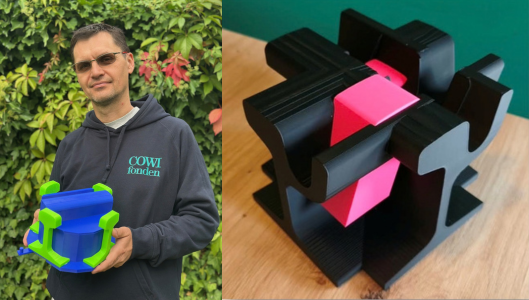
"Current fixed crossing blocks are not sufficiently effective. More efficient solutions can and should be used."
The early results are promising. The team believes both concepts could outperform traditional crossings while helping reduce noise, vibration and maintenance requirements.
For Robert, the project is part of a much bigger ambition.
The next step is to take the ideas beyond the prototype stage. Presentations at industry conferences and discussions with manufacturers are already planned, with the ultimate goal of developing a full-scale solution that can be tested in a live rail environment.
If successful, the concept could find applications wherever light rail systems operate, potentially benefiting cities and passengers around the world.
"I have always had a passion for inventions and for finding new ways of doing things that can make life and communities better."
Robert Wojtczak
Making earthquake engineering more accessible
Giovanni Li Destri Nicosia (COWI) & Alessandro Tombari (University of Exeter): Experimentally Validated Open-Source Tool for Seismic Kinematic Interaction Including Soil Liquefaction.
Some of the most important engineering challenges are also some of the least visible.
Take earthquakes.
While most people focus on what happens above ground, engineers must also understand how the ground itself behaves, particularly when soil liquefaction occurs and foundations may be subjected to additional forces from the group and may not be able to withstand the loads.
For Giovanni Li Destri Nicosia and Alessandro Tombari, the challenge was not only technical - it was also about accessibility. While advanced modelling approaches exist, they are often difficult for practising engineers to access, validate or apply confidently in real projects.
Their solution was to develop an open-source, experimentally validated tool capable of modelling the interaction between soil and pile foundations during earthquakes, including cases involving liquefaction and soil lateral spreading.
"The practising engineer who wants to do this today has very few accessible options. We wanted to create something that is validated, open and available to everyone" says Giovanni.
By validating the model against published experimental centrifuge test results and making the tool openly available, the researchers hope to provide engineers with a practical resource they can trust.
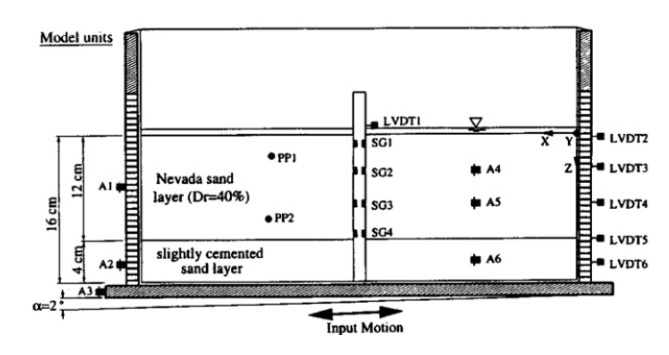
The work has applications across a wide range of projects, from bridges and buildings to offshore infrastructure. It also supports collaboration between researchers and practitioners by making complex engineering knowledge easier to access and apply.
The team is already exploring opportunities to expand the tool further using additional experimental data, helping to tackle an even broader range of real-world conditions.
"Nothing is hidden. Engineers will be able to see the model, understand how it was validated and build on it"
Giovanni Li Destri Nicosia
Turning Ideas into Impact
The four projects presented at this quarter's Rapid Innovation showcase addressed very different challenges, but they all began in much the same way: with a question.
Could bridge protection systems be made safer? Could AI become a more useful design partner? Could rail crossings be quieter? Could earthquake engineering tools be made more accessible?
The Rapid Innovation programme exists to give people the opportunity to explore those questions and see where they lead.
Not every project will transform an industry overnight. Not every prototype will become a finished product. But by creating space for experimentation, collaboration and knowledge sharing, the programme helps turn curiosity into progress.
This quarter's audience selected Ion Racu's bridge protection research as the evening's most inspiring project, but every presentation demonstrated the value of giving innovative ideas the chance to develop.
Because sometimes the next breakthrough starts with a simple question: is there a better way?
Related news
-
 21 October 2026
Global
Former COWIfonden Chair Eigil Steen Pedersen has passed away
-
 22 June 2026
Global
COWIfonden’s donations in the spring of 2026
-
 18 June 2026
Global
3D concrete printing, PISA database and more from the latest awards night
Headquarters
COWI A/S
Parallelvej 2
2800 Kongens Lyngby
Denmark
Shortcuts
Sustainability and governance
Terms of use